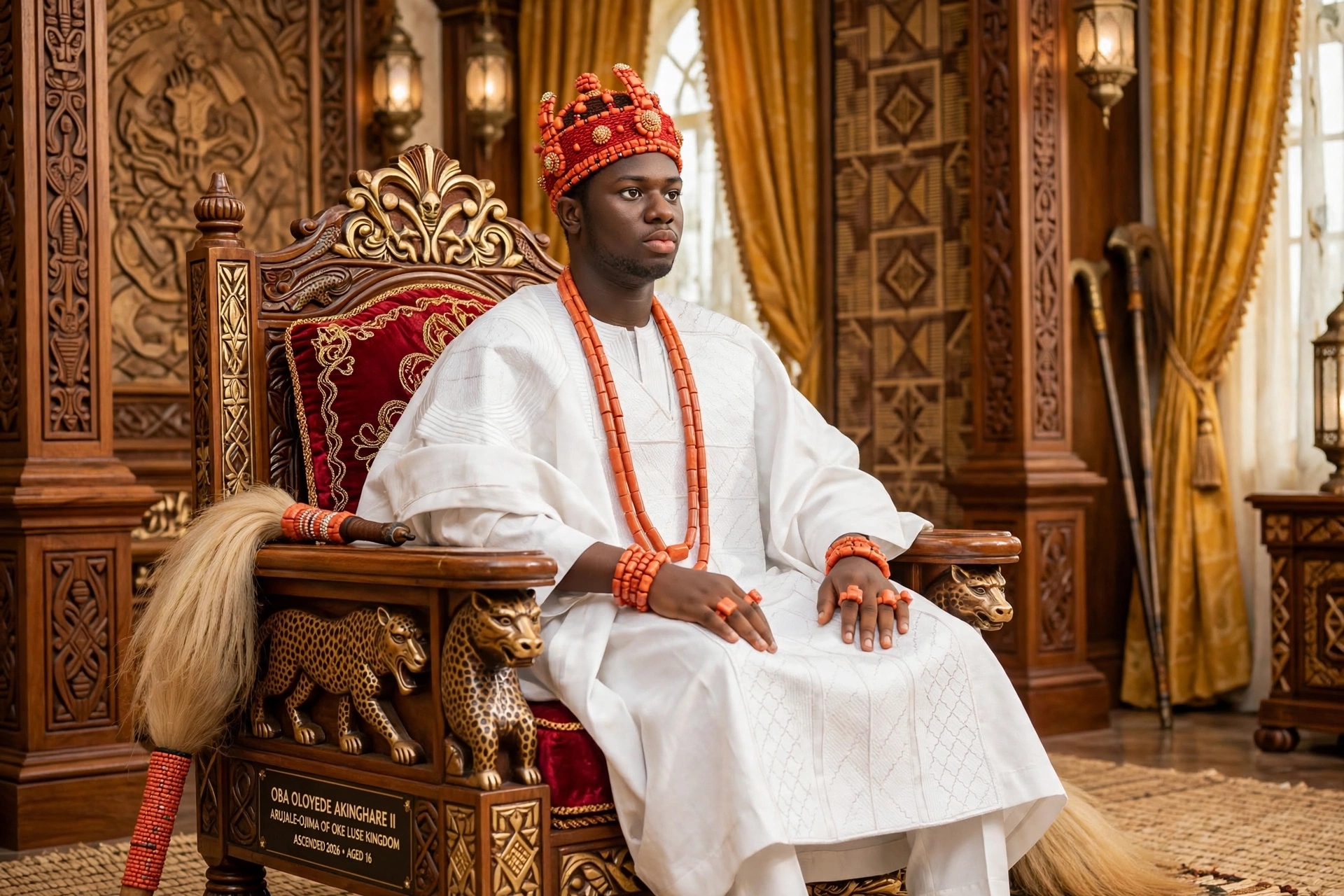
A young Nigerian king has made one thing clear: his age does not make his throne any less sacred. Imagine meeting a king who is younger than many of the people standing before him. Apparently, not if you are dealing with the palace of Oba Oloyede Akinghare II, the Arujale-Ojima of Okeluse Kingdom in Ondo State. The young monarch, who ascended the throne at just 16 following the death of his father, has warned members of the public against addressing him with casual expressions that he considers disrespectful to the throne. In a statement issued by his palace, the monarch made it clear that he is to be addressed formally as His Royal Majesty, regardless of his age or the age of the person speaking to him. The warning specifically mentioned expressions such as “bro” and “blood”, saying such forms of address were inappropriate when speaking to the traditional ruler. And that is where the story becomes more interesting. Oba Oloyede Akinghare II is not an ordinary young man who suddenly acquired a royal title. He became the traditional ruler of Okeluse Kingdom after the death of his father, Adeyeoba Omomogbe, also known as Akinghare I. His youth has made his reign unusual because traditional rulers in Nigeria are generally older men, while teenage monarchs are relatively rare, his case is not entirely without precedent, however. Dein Keagborekuzi I of Agbor Kingdom in Delta State famously became king at just two years old in 1979 and was later recognised by Guinness World Records as the world’s youngest crowned monarch. But being young did not remove the expectations attached to the throne. The palace warning was directed at everyone, regardless of age, social status or position, the message was essentially simple: the age of the monarch should not determine the level of respect given to the throne. The palace stressed that informal expressions should not be used when addressing the king and urged members of the public to respect the traditional institution.This reflects a broader aspect of Nigerian traditional culture. Across different communities, there are specific protocols for approaching and addressing traditional rulers. What is considered respectful in one kingdom may be completely different in another, for some communities, the emphasis is on the ruler’s title. In others, there are specific greetings, gestures, palace rules and even restrictions surrounding the monarch. The interesting part of the Okeluse story is not simply that a young man became king, it is the fact that once he ascended the throne, his relationship with the community changed. A person who could once be approached casually now occupies an institution that the community regards as bigger than the individual, that distinction is at the heart of many traditional systems in Nigeria. The palace statement described the throne as sacred and linked respect for the monarch with respect for the community’s heritage and identity. So, while the king may be young, the institution he represents carries generations of tradition.
And that raises an interesting question: If a 16-year-old can become king, does his age still matter once the crown is placed on his head? For the palace of Okeluse, the answer appears to be clear.
Respect the person—but never forget the throne.
Similar Posts
FBI IN NIGERIA? YAHOO BOYS HAVE BEEN CAPTURED
The question has been spreading across social media: “Is the FBI now in Nigeria?”For many young Nigerians, the question is no longer just a topic for online discussion. Recent arrests, extraditions and investigations involving Nigerian internet-fraud suspects have brought the issue much closer to home. The Federal Bureau of Investigation (FBI) is not a new…
Addressing the 2026 Surge in Student Housing Rents
Nigeria’s student housing crisis has sharpened into a clear affordability emergency. National Bureau of Statistics (NBS) data for July 2026 show rent inflation surging to 33.74%, far outpacing headline inflation, which eased to 15.43%. While overall consumer prices have moderated, the cost of a roof over a student’s head continues to climb rapidly. Off-campus clusters…
AFTER GRADUATION, THEN WHAT? NIGERIA’S SILENT WAR ON YOUNG JOB SEEKERS
The graduation gown comes off, the photographs are taken, congratulations pour in, and then reality arrives: “What next?” For many Nigerian graduates, finding a job can be harder than earning the degree itself. Applications are sent, interviews are attended, yet many employers still demand years of experience for entry level positions. It becomes a frustrating…
When Ile-Ife Becomes a Living Story: Inside the Ancient Olojo Festival
There is a particular kind of anticipation that comes over Ile-Ife when Olojo draws near. It is not simply the excitement that comes with a festival, for the people of the ancient city, Olojo is a period when history, royalty, spirituality and cultural identity seem to come together in one place. This year, the atmosphere…
WE WERE ASKED TO GET A DEGREE BUT NOBODY TOLD US THERE WOULD BE NO JOB AFTER GETTING A DEGREE
Growing up, I had one answer for everyone who asked me, “What do you want to be?” A doctor. A real medical doctor. I pictured myself in a white coat. Saving lives. Making my parents proud. But then there was mathematics. And blood. Math stood in the way like a wall I couldn’t climb. And…
Has Dating Become the Ultimate Unregulated Investment Scam?
In modern romance, a growing trend has left many questioning whether emotional involvement is turning into a calculated financial enterprise. Across online forums and social media platforms, stories circulate about partners who pour significant financial, academic, and emotional support into a relationship, only to be abruptly discarded once the recipient reaches stability or success. Sponsoring…