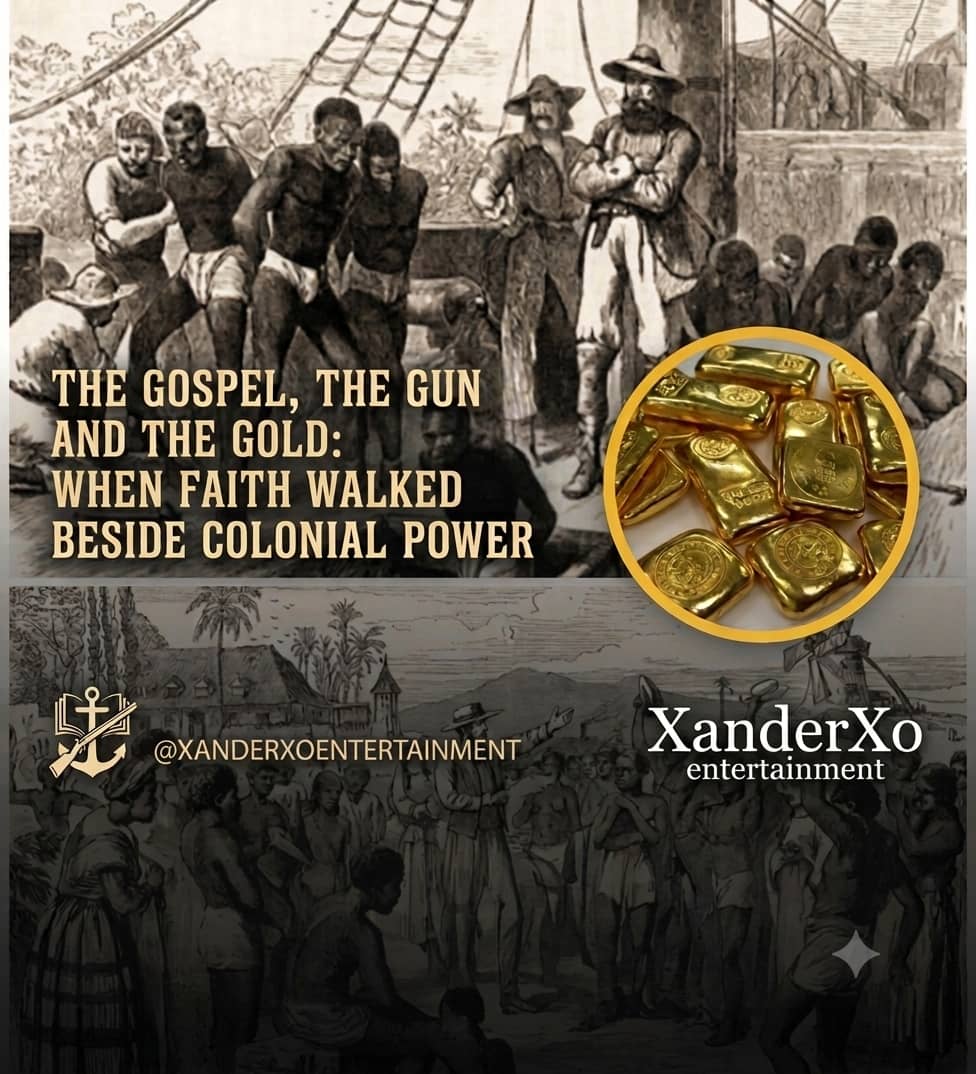
History is rarely as simple as the stories we inherit.When European missionaries arrived in different parts of Africa, they came carrying more than Bibles. They brought schools, churches, new systems of education and, in many places, a religious message that would permanently reshape African societies.But Christianity did not enter a political vacuum.Its expansion frequently occurred alongside European commercial and imperial expansion. In some regions, missionary activity became closely connected with the colonial order, while Africans themselves responded to Christianity in different ways—sometimes embracing it, sometimes resisting it, and sometimes reshaping it according to African realities. Historians have documented these complicated relationships, including in British West Africa.And this raises an uncomfortable historical question:What happens when a message about spiritual salvation enters a society at the same time that a foreign power is taking political and economic control?The answer is not simply that Christianity itself was colonialism. It wasn’t.But neither can the history of missionary Christianity in colonial Africa be completely separated from the structures of power surrounding it.Consider the language of the Bible.Jesus says:«“Blessed are the poor in spirit: for theirs is the kingdom of heaven.” — Matthew 5:3»He also says:«“Blessed are the meek: for they shall inherit the earth.” — Matthew 5:5»And again:«“Lay not up for yourselves treasures upon earth, where moth and rust doth corrupt…” — Matthew 6:19»These teachings are fundamentally spiritual and moral instructions. They were not written as a colonial economic policy.Yet history forces us to ask how such teachings could be interpreted when they were introduced into societies experiencing dispossession, forced labour, taxation, political domination and economic extraction.If the poor were told that their reward awaited them in heaven, what happened when the powerful were simultaneously accumulating wealth on earth?That contradiction deserves examination.WHEN HEAVEN BECAME THE PROMISEColonialism did not conquer Africa through religion alone.European powers possessed armies, firearms, political institutions, commercial networks and economic systems that gave them enormous advantages.But ideas matter in conquest too.A person can be physically controlled by force. A population can also be influenced by narratives about authority, obedience, civilization and legitimacy.This is where the history of missionary activity becomes particularly complicated.In some colonial settings, missionaries criticized abuses committed by colonial authorities. Some opposed particular forms of exploitation and defended African communities.In other situations, missionary institutions operated alongside colonial governments and contributed to cultural transformation that weakened or displaced existing African institutions and traditions. Historians have therefore debated whether missionary Christianity should be understood as a partner of colonialism, an opponent of some aspects of it, or both depending on the place and period.The historical picture is therefore not black and white.But there is another important part of the story:Africans were never simply passive recipients.African converts interpreted Christianity through their own experiences. African Christian movements emerged. African intellectuals challenged European control. Religious movements eventually became part of broader struggles for cultural and political independence.Christianity entered Africa through European missionary networks, but Africans eventually made the faith their own.THE QUESTION OF WEALTHPerhaps the most powerful irony of the colonial period is that Europe could preach spiritual detachment while European states and companies pursued enormous material interests overseas.Africa possessed valuable land, agricultural products, minerals and other resources that became increasingly important to European economies.The colonial project was not simply about religion.It was also about territory, labour, trade, political control and resources.And that distinction is important.To say that Christianity was used in some colonial contexts does not mean that Christianity itself created colonialism.To say that missionaries sometimes benefited from or operated within colonial structures does not mean every missionary secretly arrived with the same agenda.History becomes dangerous when complexity is replaced by mythology.The more difficult truth is that faith and empire could exist beside each other, sometimes cooperating, sometimes contradicting one another.A BIBLE CAN BE READ IN DIFFERENT WAYSThe same Bible that contains:«“Blessed are the meek: for they shall inherit the earth.” — Matthew 5:5»also contains:«“Woe unto them that join house to house, that lay field to field, till there be no place…” — Isaiah 5:8»And:«“The labourer is worthy of his hire.” — Luke 10:7»These passages complicate any attempt to reduce Christianity to a doctrine of passive suffering.The Bible contains teachings about humility, sacrifice and patience.But it also contains teachings about justice, oppression, exploitation, human dignity and the treatment of the poor.That is why the historical question should not simply be:“Did Christianity make Africans accept colonialism?”A better question is:“How did colonial powers, missionaries and African communities interpret and use Christianity within a system of unequal political and economic power?”That question takes us much deeper.FROM COLONIAL SUBJECTS TO AUTHORS OF THEIR OWN HISTORYOne of the most fascinating developments in African history is that Christianity eventually became a language through which Africans themselves challenged European authority.African Christian leaders, intellectuals and movements did not simply reproduce European ideas.They adapted Christianity.They questioned missionary authority.They defended African identity.They created independent churches.And in different parts of the continent, Christian ideas became intertwined with emerging African nationalism and demands for political independence. Scholars of African Christianity have documented this transformation from missionary Christianity toward forms increasingly shaped by Africans themselves.That is perhaps the greatest historical irony.A religion introduced through European missionary networks eventually became, in African hands, one of the tools through which Africans could articulate their own dignity, identity and political aspirations.THE HISTORY WE SHOULD REMEMBERThe colonial story cannot honestly be reduced to “Europeans brought Christianity to deceive Africans.”Neither can it be reduced to “Europeans brought Christianity and civilization to Africa.”Both versions erase too much history.The reality was more complicated.There were missionaries who genuinely believed they were serving God.There were colonial officials pursuing political and economic interests.There were Africans who embraced Christianity sincerely.There were Africans who resisted it.There were Africans who combined Christianity with African cultural traditions.There were missionaries who challenged colonial abuses.And there were situations in which missionary institutions became entangled with colonial power.The historian’s responsibility is to hold all of these realities together.Because perhaps the most important lesson is not whether Christianity was “good” or “bad.”It is that religion, politics and economics can become extraordinarily powerful when they operate together.And whenever a powerful institution tells a powerless population to accept suffering, history demands that we ask one more question:Who benefits from that suffering?Africa’s future cannot be built by waiting for salvation from another continent.It must be built through education, institutions, economic development, political accountability, technological capacity and the responsible management of African resources.And for Christians, there is an equally important question:If the Bible speaks about justice, dignity, compassion and the treatment of the poor, then those principles must matter not only in the hope of heaven—but also in how human beings treat one another on earth.The history of colonial Africa reminds us of something powerful:A people can lose territory, wealth and political power. But they become truly vulnerable when they lose the ability to question the story being told about their own suffering.History gives Africans the opportunity to recover that ability.Not by rejecting history.But by studying it.Not by rejecting faith.But by questioning how faith has been used.And not by waiting for someone else to build Africa’s future.But by becoming the authors of it.#HistoricalAfrica #ColonialHistory #AfricanHistory #AfricanSovereignty #XanderXO
Similar Posts
Addressing the 2026 Surge in Student Housing Rents
Nigeria’s student housing crisis has sharpened into a clear affordability emergency. National Bureau of Statistics (NBS) data for July 2026 show rent inflation surging to 33.74%, far outpacing headline inflation, which eased to 15.43%. While overall consumer prices have moderated, the cost of a roof over a student’s head continues to climb rapidly. Off-campus clusters…
THE RISE OF FAKE PRODUCTS IN NIGERIA: WHAT EXACTLY ARE WE BUYING?
There was a time when the word “fake” in Nigeria mostly brought to mind imitation clothes, shoes, phones or designer products.Today, the question is becoming much more serious:What if the product we are calling fake is something we are eating, drinking, applying to our bodies or taking as medicine?That is the disturbing reality behind Nigeria’s…
AFTER GRADUATION, THEN WHAT? NIGERIA’S SILENT WAR ON YOUNG JOB SEEKERS
The graduation gown comes off, the photographs are taken, congratulations pour in, and then reality arrives: “What next?” For many Nigerian graduates, finding a job can be harder than earning the degree itself. Applications are sent, interviews are attended, yet many employers still demand years of experience for entry level positions. It becomes a frustrating…
Muse Spark vs ChatGPT: Which AI is Better for Writers in 2026?
As a writer who has already published 2 stories, I’m always testing new tools. I used AI for ideas and finding the right words, but not to write the whole thing.In April 2026 Meta dropped Muse Spark, and everyone started asking: “Is this better than ChatGPT?”I tested both. One gave me ideas fast. The other…
BEFORE THE FACTORIES WENT SILENT: 5 NIGERIAN INDUSTRIAL GIANTS THAT ONCE EMPLOYED THOUSANDS
There was a time when Nigeria wasn’t just a huge market for imported products. The country had factories producing cars, tyres, shoes, paper and textiles with thousands of Nigerians working in them.Here are five companies that tell the story of that era.
How to Apply for the US Army as a Non-Citizen in 2026: Requirements, Green Card & Citizenship Process
Many Nigerians and other foreigners ask if it’s possible to join the United States Armywithout being a U.S. citizen.The short answer is yes, but with conditions. You don’t need to be a U.S. citizen to enlist, but you must be a legal U.S. resident. According to U.S. Army recruiting guidelines, non-citizens must meet these requirements:…